
Donna Sicuranza: Her Verified Career and Leadership at TEAM
Donna Sicuranza—currently listed by TEAM as Donna Sicuranza Marconi—is the executive director of Tait’s Every Animal Matters, a nonprofit charity headquartered in Westbrook, Connecticut. TEAM credits Sicuranza and veterinarian John A. Caltabiano with directing the development of its mobile feline spay-and-neuter clinic, which entered service on March 1, 1997. The organization currently reports that its veterinary team has sterilized and vaccinated more than 225,000 cats across Connecticut. (TEAM staff directory; TEAM clinic history)
Her documented public profile centers on nonprofit leadership, communications and animal welfare—not entertainment or celebrity. Because search results sometimes combine her with unrelated people, this profile separates verified facts from unsupported biographical claims.
Donna Sicuranza at a Glance
| Detail | Verified information | Source |
|---|---|---|
| Current professional name | Donna Sicuranza Marconi | TEAM staff directory |
| Earlier published name | Donna Sicuranza or Donna J. Sicuranza | TEAMWORKS newsletter |
| Current position | Executive Director | TEAM staff directory |
| Organization | Tait’s Every Animal Matters, commonly called TEAM | TEAM About page |
| Professional field | Nonprofit leadership and animal welfare | TEAM and public nonprofit records |
| Earlier career | Journalism and public relations | Connecticut Magazine |
| Principal program | TEAM Mobile Feline Spay/Neuter Clinic | TEAM clinic history |
| Program launch | March 1, 1997 | TEAM clinic history |
| Current published impact | More than 225,000 cats sterilized and vaccinated | TEAM About page |
| Veterinary status | Administrative leader, not listed as a veterinarian | TEAM staff directory |
Who Is Donna Sicuranza?
Donna Sicuranza is a Connecticut nonprofit executive whose career is closely connected to the development and continued operation of TEAM’s mobile feline clinic.
TEAM’s current staff directory lists her as Donna Sicuranza Marconi and places her under administrative staff. Medical Director Art Heller, DVM, and the veterinary technicians appear separately under veterinary staff. This structure establishes that Sicuranza holds an administrative leadership position rather than a clinical veterinary role.
IRS-derived nonprofit records also list Donna Sicuranza among the organization’s officers, supporting the documented continuity of her leadership position. These records concern organizational governance; they do not provide a complete personal biography. (ProPublica Nonprofit Explorer)
Her Background in Journalism and Public Relations
Before her work at TEAM became her primary public identity, Sicuranza worked in journalism and public relations.
A 2013 Connecticut Magazine report described her as a friend of veterinarian John Caltabiano who was working in those fields when TEAM’s mission was being developed. The article records Sicuranza explaining that public inquiries repeatedly raised concerns about unwanted kittens, uncontrolled reproduction and limited options for cat caretakers.
Her communications background is therefore a verified part of her career. It is reasonable to conclude that those skills were relevant to explaining a new mobile-clinic model to the public. However, available sources do not document every communications or administrative task she personally performed, so those responsibilities should not be stated as fact without additional evidence.
How TEAM’s Mobile Clinic Began
TEAM grew out of an earlier animal-adoption initiative established by John A. Caltabiano. According to Connecticut Magazine, a bequest from New Haven businessman and animal supporter Vernon A. Tait helped Caltabiano reestablish the nonprofit under the name Vernon A. Tait All-Animal Adoption, Preservation and Rescue Fund. Tait’s Every Animal Matters, shortened to TEAM, became its public-facing name.
Calls from Connecticut residents helped reveal a recurring problem: communities were dealing with unwanted litters and growing populations of homeless cats, while many caretakers had difficulty accessing affordable sterilization services.
TEAM’s official history states that plans for a mobile solution began in 1996 under the direction of Caltabiano and Sicuranza. Instead of expecting every owner or caretaker to reach one permanent facility, the proposed clinic would take selected veterinary services to scheduled communities.
The first TEAM Mobile Feline Spay/Neuter Clinic began operating on March 1, 1997. Ten cats were sterilized and vaccinated on its first day. TEAM reports that the program reached 5,000 cats within six months and approximately 8,000 by its first anniversary.
Source-Backed Timeline
| Date | Documented milestone | Source |
|---|---|---|
| 1996 | Planning for the mobile clinic began under John Caltabiano and Donna Sicuranza | TEAM clinic history |
| March 1, 1997 | The mobile clinic completed procedures for 10 cats on its first day | TEAM clinic history |
| First six months | TEAM reported serving 5,000 cats | TEAM clinic history |
| First anniversary | TEAM reported approximately 8,000 procedures | TEAM clinic history |
| 2013 | Independent reporting placed the cumulative total at approximately 160,000 | Connecticut Magazine |
| 2019 | TEAM celebrated its 200,000th spay-or-neuter procedure | TEAMWORKS newsletter |
| Current published figure | TEAM reports more than 225,000 cats sterilized and vaccinated | TEAM About page |
The figures come from different publication dates and should be understood as cumulative milestones, not annual totals. The current figure should be rechecked against TEAM’s website whenever this article is updated.
What Public Records Establish About Her Role
Available sources support four specific conclusions about Sicuranza’s work:
- She participated with Caltabiano in planning and launching the mobile clinic.
- TEAM currently identifies her as its executive director.
- The 2019 edition of TEAM’s TEAMWORKS newsletter identified Donna Sicuranza as its editor.
- She has represented TEAM in independent media coverage, including reports published by Connecticut Magazine and Patch.
A 2021 Patch interview provides useful context for how Sicuranza described the program. She explained that TEAM was not attempting to replace conventional veterinary hospitals. Its more focused purpose was to make selected services available to Connecticut cat owners who might otherwise struggle to afford them. (Patch)
These sources document leadership, public communication and involvement in the clinic’s development. They do not show that Sicuranza personally performed veterinary procedures or individually managed every operational activity associated with the program.
What the TEAM Mobile Clinic Does
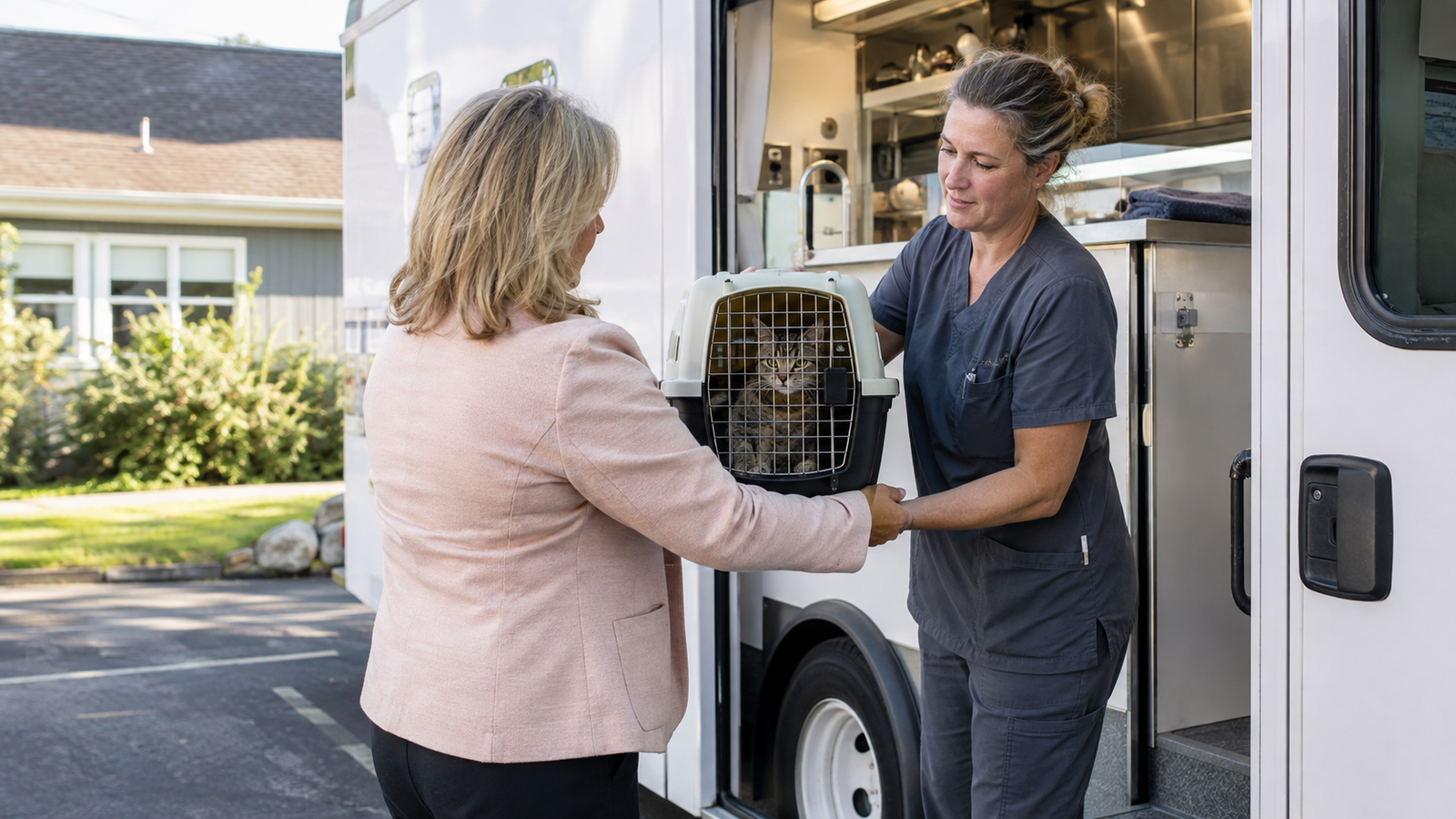
The TEAM Mobile Feline Spay/Neuter Clinic travels to scheduled locations in Connecticut. Its central service is spay-or-neuter surgery for eligible cats, accompanied by specified vaccinations and related basic care.
TEAM’s current service information establishes several important boundaries:
- The cats and their caregivers must be residents of Connecticut.
- Domestic and feral cats are accepted, subject to current requirements.
- Medical eligibility is determined under the program’s veterinary rules.
- Locations, prices and schedules may change.
- Appointments and current requirements must be confirmed directly with TEAM.
The organization also supports trap-neuter-return activity for feral cats. TEAM’s website states that qualifying caretakers may be eligible for a partial rebate through its incentive program. (TEAM feral-cat information)
TEAM is therefore best understood as a specialized preventive-care program, not a replacement for comprehensive, emergency or ongoing veterinary treatment.
Why the Mobile Model Matters
The significance of the mobile model can be explained without assigning undocumented duties to Sicuranza.
A fixed clinic requires clients to reach one location. TEAM instead schedules services in multiple Connecticut communities, reducing a geographic barrier for some owners and caretakers. Its concentration on feline sterilization and vaccination also gives the organization a clearly defined operational purpose.
The growth from 10 cats on the first day to more than 225,000 reported procedures indicates long-term organizational continuity. It does not prove that one individual performed every function behind that growth. It does, however, provide measurable context for the program Sicuranza helped establish and continues to represent as executive director.
Why Search Results for Donna Sicuranza Can Be Misleading
Several different records appear around the name “Donna Sicuranza.” They should not be combined.
| Search result | What the source actually establishes | Correct interpretation |
|---|---|---|
| Donna Sicuranza Marconi | TEAM currently uses this name for its executive director | This is the current professional name associated with the TEAM role |
| Donna Marie Sicuranza obituary | Describes a New York banking professional born in 1942 who died in 2017 | This is a different person |
| Blondie Wikipedia article | Mentions Barbara Sicuranza in connection with the “Mother” music video | It does not identify Donna Sicuranza or establish a connection to her |
| Unsupported biography claims | Some websites publish personal or celebrity-related details without reliable attribution | These claims should not be repeated without authoritative evidence |
The Pelham Funeral Home obituary concerns Donna Marie Sicuranza, a former Mount Vernon and New Rochelle resident who worked for Walker Studios and the Bank of New York. TEAM, meanwhile, currently identifies Donna Sicuranza Marconi as its executive director. Their careers and documented histories are different.
The supplied Wikipedia article about Blondie is similarly unrelated. It names Barbara Sicuranza among the cameo appearances in Blondie’s 2011 “Mother” video; it does not name Donna Sicuranza.
What Remains Unverified
The reliable sources reviewed for this article do not establish Sicuranza’s date of birth, education, current marital status, children or personal net worth.
This does not prove that such information does not exist. It means that a responsible article should not present specific claims about those subjects without a credible source directly connected to the correct individual.
Frequently Asked Questions
What is Donna Sicuranza known for?
Donna Sicuranza is known for her leadership at Tait’s Every Animal Matters and her role in developing TEAM’s mobile feline spay-and-neuter clinic in Connecticut.
What is Donna Sicuranza’s current position?
TEAM’s official staff directory lists Donna Sicuranza Marconi as executive director.
Are Donna Sicuranza and Donna Sicuranza Marconi the same person?
TEAM’s historical materials use Donna Sicuranza or Donna J. Sicuranza, while its current staff page uses Donna Sicuranza Marconi for the same executive-director role.
Is Donna Sicuranza a veterinarian?
No source reviewed identifies her as a veterinarian. TEAM lists her under administrative staff and identifies its veterinary personnel separately.
When did TEAM’s mobile clinic begin?
The clinic began operating on March 1, 1997, after planning started in 1996.
How many cats has TEAM served?
TEAM currently reports that its veterinarians have sterilized and vaccinated more than 225,000 cats since 1997.
Is Donna Sicuranza connected to Blondie?
No verified connection was found. The Blondie Wikipedia article mentions Barbara Sicuranza, not Donna Sicuranza.
What is Donna Sicuranza’s age or net worth?
Neither her age nor her personal net worth has been established by a reliable source reviewed for this article.
A Career Grounded in Animal-Welfare Work
Donna Sicuranza’s verified public story is defined by her long association with Tait’s Every Animal Matters.
Her background in journalism and public relations preceded her work with John Caltabiano on a mobile solution to a documented animal-welfare problem. The clinic that began with 10 cats in March 1997 has since become a long-running Connecticut program with more than 225,000 reported procedures.
The strongest biography of Sicuranza is therefore not one built around speculative personal details. It is the source-backed account of a nonprofit executive who helped establish and sustain a specialized model for making feline sterilization and vaccination services more accessible.
Sources and Evidence
Primary and organizational sources
- TEAM staff directory — current name, position and staff classification
- TEAM clinic history — planning, launch and early milestones
- TEAM About page — organization, service model and current published total
- TEAMWORKS 2019 newsletter — 200,000th procedure and editorial role
- ProPublica Nonprofit Explorer — IRS-derived organizational and officer records
Independent and clarification sources
- Connecticut Magazine — earlier career, TEAM’s origins and 2013 milestone
- Patch — independent interview and explanation of the clinic’s scope
- Pelham Funeral Home obituary — evidence concerning the different Donna Marie Sicuranza
- Blondie Wikipedia article — confirmation that the page mentions Barbara Sicuranza rather than Donna
Leave a Reply